The Short Answer
A strong artist statement for a portfolio PDF is:
- 150–300 words
- written in the first person
- structured in two or three short paragraphs
- focused on one clear idea
Clarity matters more than literary ambition.
If you want the full portfolio structure this statement fits into, see the artist portfolio PDF guide.
Why Artist Statements Are So Hard to Write
Most artists find the statement the hardest part of the portfolio.
Not because they cannot write.
Because they are not sure what the statement is actually for.
A statement is not:
- a press release
- an academic essay
- a personal manifesto
- a description of every project you have ever made
A statement is a short professional introduction to your practice.
Its job is to help a reviewer understand your work before they look at it.
That is all.
What Curators and Juries Actually Read
Selection panels review dozens or hundreds of applications in short sessions.
For most reviewers, the statement serves one purpose:
to decide whether to look at the work carefully or move on quickly.
What they are looking for:
- a clear sense of what you make
- a clear sense of why you make it
- language they do not have to decode
What makes them stop reading:
- an opening sentence that begins with "My work explores..."
- abstract language without a concrete anchor
- a statement longer than one page
- a statement that could belong to any artist
The 5 Opening Sentences to Avoid
These are the most common opening lines in artist statements.
Every reviewer has read them hundreds of times.
- "My work explores the relationship between..."
- "I am interested in the intersection of..."
- "Through my practice, I examine..."
- "My work investigates questions of..."
- "I use [medium] to explore themes of..."
These sentences are not wrong.
They are invisible.
They signal that the statement was written quickly, without thinking about the reader.
A Structure That Works Everywhere
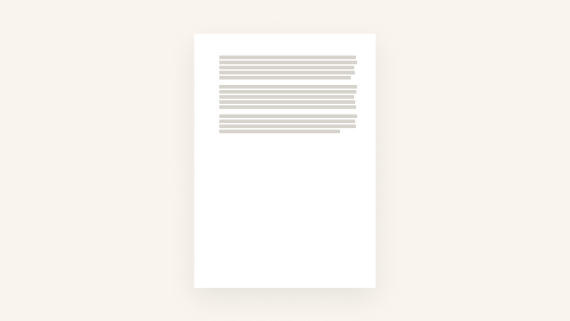
Most strong statements follow a simple three-paragraph structure.
Paragraph 1 — What you make
Name the work directly. Medium, form, subject. One or two sentences.
Paragraph 2 — How you work
Describe the process or approach that shapes the work. What decisions do you make and why.
Paragraph 3 — Why it matters
Situate the work. What questions does it open? What context does it respond to?
This is not a formula.
It is a reading logic.
Reviewers move from what to how to why naturally.
Your statement should move the same way.
Statement vs Biography — The Most Common Confusion
Many artists mix up these two documents.
The statement is about the work.
The biography is about the person.
A statement should not include:
- where you were born
- which school you attended
- which exhibitions you have had
Those belong in the biography and CV.
The statement should focus entirely on the practice — not on the practitioner's history.
If you want to see working models, read artist statement examples and artist statement examples for painters.
Length and Tone
Most institutional applications ask for a statement.
Few specify exact length.
A safe range for almost any context:
- Minimum: 100 words (risks feeling thin)
- Optimal: 150–250 words
- Maximum: 300 words
Beyond 300 words, most reviewers stop reading.
Tone should be:
- direct, not performative
- specific, not abstract
- confident, not defensive
Write as if you are explaining your work to an intelligent stranger
who has no background in contemporary art.
A Short Example
This is a fictional example of a clear, well-structured statement.
Sloane Whitfield paints domestic interiors using oil and encaustic on panel. The rooms she depicts no longer exist — they are reconstructed from memory, architectural fragments, and the physical residue of earlier paintings buried beneath the surface.
Her process involves building up and eroding layers of encaustic over weeks or months. The surface becomes a record of time: earlier decisions remain visible beneath the present one, creating a stratigraphy that mirrors how memory accumulates and distorts.
The work asks what it means to feel at home in a space that exists only in paint — and whether familiarity and estrangement can occupy the same room at once.
This statement is 112 words.
It names the medium, describes the process, and opens a question.
It could belong only to this artist.
The Test
Before submitting your statement, ask three questions:
Could this statement belong to another artist?
If yes, it is too generic. Add one specific detail that anchors it to your practice.Does it describe the work or describe you talking about the work?
Remove any sentence that begins with "I find myself" or "I am drawn to."Would a non-specialist understand it?
If not, cut the jargon or replace it with a concrete image.
Where the Statement Goes in the Portfolio PDF
The statement appears before the artworks, usually as the second page after the cover.
Standard order:
- Cover page
- Artist statement
- Biography
- CV
- Selected artworks
Placing the statement early ensures the reviewer reads it before forming a visual impression.
It frames the work before the work is seen.
If the CV still needs work, pair this with the artist CV template.
Why I Built MyArtPDF
MyArtPDF includes a dedicated writing view for the artist statement.
It shows the recommended word count as you write,
and keeps the statement visible alongside the live PDF preview.
No separate document. No copy-pasting.
The statement is part of the portfolio from the start.
All offline, with no login and no tracking.
You can read more about this philosophy in the MyArtPDF manifesto.
Try MyArtPDF
If you'd like to build a portfolio with a clear statement structure:
One email at launch. No spam.
Author
I'm Alexandre Desane — visual artist & indie developer.
I build quiet tools for artists.