The Short Answer
When sending a portfolio to a gallery, you need:
- A focused PDF — 10–15 artworks, clean layout, consistent captions
- A short email — three to four sentences, no attachments unless requested
- A link or attached PDF — depending on the gallery's preference
- A brief artist statement — 150–300 words, already inside the PDF
Most gallery submissions fail before the PDF is opened.
The email is the first filter.
For the full portfolio structure, see:
https://myartpdf.app/artist-portfolio-pdf
What Happens When a Gallery Receives Your Submission
Most working gallerists receive between 10 and 50 unsolicited submissions per week.
They do not open all of them.
The first filter is the email subject line and opening sentence.
The second filter is whether the PDF loads quickly and looks professional in the first three seconds.
The third filter is whether the work is relevant to the gallery's program.
A portfolio that passes all three filters gets a real look.
A portfolio that fails any one of them rarely does.
Understanding this process is more useful than any list of formatting rules.
Research the Gallery Before Sending Anything
This is the step most artists skip.
Sending a portfolio to a gallery without knowing their program is one of the most common — and most visible — mistakes.
Gallerists can tell immediately when a submission is part of a mass mailing.
Before sending, spend ten minutes answering these questions:
- What kind of work does this gallery show?
- Who are their current artists?
- Is my practice genuinely relevant to their program — or am I reaching?
- Have they shown work at a similar stage of career?
- Do they accept unsolicited submissions?
If the gallery does not accept unsolicited submissions, do not submit.
It does not help, and it signals that you did not read their website.
If the work is genuinely relevant, the submission becomes a targeted approach — not a cold email.
The Email
The email is not a cover letter.
It should be short, direct and specific.
A strong gallery submission email has four elements:
- One sentence on who you are — your practice in plain language
- One sentence on why you are contacting this gallery specifically — show that you know their program
- One sentence on what you are sending — PDF attached, or link to your portfolio
- One sentence on next steps — you are happy to send additional work or answer questions
Total: three to five sentences.
What to avoid:
- Opening with "I hope this email finds you well"
- Describing your work in abstract or theoretical language
- Listing every exhibition you have ever had
- Attaching a CV to a cold submission email — include it inside the PDF
- Writing more than one short paragraph
The email should make the gallerist want to open the PDF.
It is not where you make your case — the PDF is.
The Subject Line
The subject line determines whether the email is opened.
Keep it simple and specific:
Artist submission — [Your name]
or
Portfolio — [Your name], [Medium]
Do not use:
- "Collaboration opportunity"
- "Exciting new work"
- "Following up on my practice"
- Anything that sounds like a marketing email
A clear, professional subject line signals that you understand how galleries work.
The PDF — What Gallerists Actually Open
When a gallerist opens your PDF, they are making a fast judgment.
In the first 10 seconds they register:
- Does this look professional?
- Is the work visually strong?
- Does the layout get out of the way of the images?
In the next 30 seconds they scan:
- The first three or four artworks
- The captions — medium, year, dimensions
- The cover page or first page for the artist's name
If the work is interesting, they read the statement.
If the statement is clear and specific, they look at the CV.
This is the reading sequence.
Your PDF should be structured to support it — not to fight it.
The Gallery Portfolio Structure
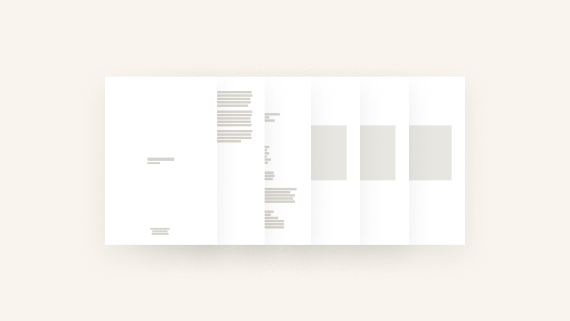
For gallery submissions, the standard structure is:
- Cover page — name, "Portfolio", year
- Artist statement — 150–300 words
- Biography — 80–150 words
- CV — 1–2 pages
- Selected artworks — 10–15 works, one per page
Some gallerists prefer to see the work before the text.
If the gallery has specific preferences, follow them.
When no preference is stated, text before artworks is the safer default.
Selecting the Right Works for a Gallery Submission
Do not send your full body of work.
Send the 10 to 15 works that are most relevant to this gallery's program.
If you paint large-scale abstractions and are approaching a gallery that shows intimate figurative work, no amount of polished formatting will make the submission land.
The selection should feel like it was made for this gallery — even if the underlying portfolio is the same document you send elsewhere.
What to prioritize:
- Recent work — within the past two to three years when possible
- Work that reflects your current direction
- Work that is consistent in medium, scale or conceptual approach
- Your strongest images — not your most recent if the most recent is not yet strong
What to avoid:
- Including work in progress without context
- Mixing too many mediums or styles in one selection
- Including documentation of sold works unless the image is exceptional
Captions
Every work needs a complete, consistent caption.
Standard format:
Title, Year, Medium, Dimensions
Example:
Study for Yellow Interior, 2025, oil on linen, 40 × 50 in.
For galleries specifically, also consider adding:
Available / Sold / In collection of [Institution]
Availability information is relevant in a gallery context in a way it is not in a residency or MFA application.
If all works are available, you do not need to note it.
If some are sold or in collections, noting it signals market activity — which matters to galleries.
File Format and Technical Basics
Most galleries accept PDF submissions.
Technical requirements to follow without exception:
- File size: under 10MB — larger files do not always open in email previews
- Page format: A4 or US Letter depending on the gallery's location
- Color profile: sRGB throughout — CMYK can shift colors unexpectedly on screen
- Images: 2000px on the long edge, JPEG, quality 85–90%
- File name:
LastName_FirstName_Portfolio_2026.pdf
Do not send:
- ZIP files with individual images
- WeTransfer links that expire in seven days
- Google Drive links that require a login to view
- Files larger than 20MB
If you want to share a link rather than an attachment, use a direct, publicly accessible PDF link — not a folder, not a file request, not a platform that requires an account.
When to Follow Up
If you have not received a response after three to four weeks, one follow-up is appropriate.
Keep it shorter than the original email:
I wanted to follow up on the portfolio I sent on [date].
Happy to provide additional work or answer any questions.
Do not follow up more than once on an unsolicited submission.
A non-response is itself a response.
Most galleries do not respond to every submission they receive — that is normal, not a judgment on the work.
What a Response Actually Means
A positive response to a portfolio submission is not an offer of representation.
It usually means:
- the gallerist wants to see more work
- they want to meet in person or on a call
- they are keeping you in mind for a group show or future program
Representation is a longer process built on ongoing relationship — not a single submission.
The goal of the submission is to open a conversation, not to close a deal.
The Most Common Gallery Submission Mistakes
In order of frequency:
- Submitting to galleries whose program is irrelevant to your work — the most common and most damaging mistake
- Email too long — gallerists stop reading after the first paragraph
- PDF too large — does not open in email preview, gets set aside
- Generic statement — no sense of what makes your practice specific
- No captions or inconsistent captions — signals carelessness
- Following up more than once — signals impatience, not persistence
- Attaching a CV separately — keep it inside the PDF
- Sending the same portfolio to every gallery — the selection should feel targeted
Why I Built MyArtPDF
Every gallery submission starts with the same preparation: choosing the works, writing the statement, formatting the captions, exporting the PDF.
MyArtPDF keeps that preparation in one place.
When a new opportunity comes up — an open call, a cold submission, an introduction from a colleague — the portfolio is already structured.
You update the selection and the statement.
The layout and export are handled.
All offline, with no login and no tracking.
You can read more about this philosophy here:
https://myartpdf.app/manifesto
Try MyArtPDF
If you'd like to build a gallery submission portfolio with a clear structure:
https://myartpdf.app/#early-access
One email at launch. No spam.
Author
I'm Alexandre Desane — visual artist & indie developer.
I build quiet tools for artists.