The Short Answer
A residency application portfolio is a structured PDF that combines:
- 10–15 selected artworks
- an artist statement (150–300 words)
- a short biography (80–200 words)
- a CV (1–2 pages)
The order matters. The file size matters. The clarity of captions matters.
Most rejections are not about the work.
They are about a portfolio that was difficult to read.
For the full standard portfolio structure, see:
https://myartpdf.app/artist-portfolio-pdf
What Residency Committees Actually Do With Your PDF
Understanding the review process changes how you prepare the document.
Most residency programs receive between 200 and 1,500 applications per cycle.
Selection committees are often small — two to five people reviewing everything in a short window.
In a first pass, a reviewer typically spends 30 to 90 seconds on each application.
In that time they are looking for:
- a coherent body of work
- a readable document
- a statement that situates the practice quickly
- a CV that confirms professional activity
If the PDF is slow to open, poorly structured, or hard to scan, it moves to the bottom of the pile — regardless of the quality of the work.
Your portfolio is not just a selection of images.
It is a document designed to be reviewed under pressure.
How a Residency Portfolio Differs From a Gallery Portfolio
The difference is subtle but real.
A gallery portfolio is primarily about the work — its visual quality, coherence, and market positioning.
A residency portfolio is about the work and the artist's capacity to use the residency productively.
Selection committees are asking:
- Is this practice developed enough to benefit from time and space?
- Does the statement suggest a clear direction?
- Does the CV indicate professional engagement — even at an early stage?
This means the statement and biography carry more weight in a residency application than in a gallery submission.
Do not treat them as afterthoughts.
The Standard Residency Portfolio Structure
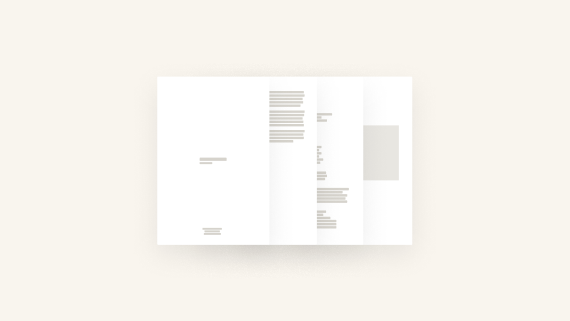
Most residency applications expect this order:
- Cover page — name, "Portfolio", year
- Artist statement — 150–300 words
- Biography — 80–200 words
- CV — 1–2 pages
- Selected artworks — 10–15 works, one per page
Some programs ask for the CV before the statement.
Always check the specific call guidelines.
When in doubt, use the order above.
It follows a reading logic — introduce, contextualize, frame, show — that most committees expect.
The Artist Statement for Residency Applications
The statement is the first thing many reviewers read carefully.
For residency applications specifically, the statement should signal:
- what you are currently working on — not a general overview of your whole practice
- why this moment in your work matters — what questions you are pursuing right now
- what you would do with uninterrupted time — implicitly, without writing a project proposal
You do not need to write a project proposal unless the call asks for one.
The statement should be about the practice, not about a specific residency outcome.
Common mistakes in residency statements:
- Writing about past work only, with no sense of current direction
- Being so abstract that the work remains invisible
- Writing a project proposal disguised as a statement
- Exceeding 300 words
The Biography for Residency Applications
The biography situates you as a practitioner.
For residency applications, include:
- current base — city and country
- medium or practice area — briefly
- key exhibitions or recognitions — two or three maximum
- education — if relevant and recent
Keep it under 200 words.
Do not repeat information that is already in your CV.
The biography is a human introduction, not a compressed CV.
The CV for Residency Applications
A residency CV follows the same structure as any artist CV.
Sections in order of importance:
- Exhibitions — solo first, then group, reverse chronological
- Education — most recent first
- Residencies — previous residencies, if any
- Awards and grants
- Collections — if applicable
- Publications and press — if applicable
For emerging artists with shorter CVs:
do not pad the document with irrelevant experience.
A focused CV of one page is stronger than a two-page CV that includes unrelated work.
Selection committees understand that emerging artists have shorter CVs.
What they notice is whether the existing activity is coherent and honest.
Selecting and Sequencing the Artworks
Most residency applications ask for 10 to 15 artworks.
Selection principles:
- Show work from the past two to three years when possible
- Prioritize coherence over variety — a focused selection reads as intentional
- Include installation views or detail shots if they add information
- Avoid including work that feels unresolved or experimental without context
Sequencing principles:
- Open with your strongest, most representative work
- Build coherence in the middle — let the works speak to each other
- End with something that suggests direction, not conclusion
For a detailed sequencing method, read:
https://myartpdf.app/blog/how-artists-should-sequence-their-portfolio-2026/
Captions and Metadata
Every artwork should have a consistent caption.
Standard format:
Title, Year, Medium, Dimensions
Example:
Interior with Closed Door, 2023, oil and encaustic on panel, 36 × 48 in.
For installation views, add:
Installation view, [Exhibition name], [Venue], [Year]
Inconsistent captions — missing years, varying dimension formats, no medium — signal carelessness.
Selection committees notice.
Technical Requirements
Most residency portals specify:
- File format: PDF
- File size: usually 10–20MB maximum
- Page count: often 15–25 pages
Check the specific call before exporting.
General safe targets:
- Keep images at 2000px on the long edge, exported as JPEG at quality 85–90%
- Use sRGB color profile throughout
- Export in A4 (Europe) or US Letter (North America) depending on the program's location
- Name the file clearly:
LastName_FirstName_Portfolio_2026.pdf
Test the PDF on a second device before uploading.
Check that it opens on the correct first page and that all images are sharp.
The Most Common Residency Portfolio Mistakes
In order of frequency:
- File too large — the portal rejects it or it loads slowly
- Statement too long — reviewers stop at 300 words
- No captions or inconsistent captions — signals carelessness
- Artwork on the cover — non-standard, often seen as overdesigned
- Wrong page format — sending A4 to a US program or Letter to a European one
- CV longer than two pages — harder to scan during first pass
- Statement about past work only — no sense of current direction
- Too many artworks — more than 15 usually dilutes the selection
For the complete list of portfolio mistakes, read:
https://myartpdf.app/blog/artist-portfolio-mistakes-2026/
A Note on Project Proposals
Many residency applications ask for a separate project proposal in addition to the portfolio.
The project proposal and the artist statement are not the same document.
- Statement: describes your practice as it currently exists
- Project proposal: describes what you plan to make or research during the residency
If a project proposal is required, keep it focused and realistic.
Committees are not looking for a guaranteed outcome.
They are looking for evidence that you think clearly about your work and can use time well.
Why I Built MyArtPDF
Residency applications were the primary reason I built this tool.
Every cycle, I rebuilt the same PDF — adjusting the layout, re-exporting images, reformatting the CV — with tools that were never designed for this workflow.
MyArtPDF keeps everything in one place: statement, biography, CV, artworks, captions and export settings.
When the deadline arrives, the document is already structured.
You update the content, not the layout.
All offline, with no login and no tracking.
You can read more about this philosophy here:
https://myartpdf.app/manifesto
Try MyArtPDF
If you'd like to build a residency portfolio with a clear structure:
https://myartpdf.app/#early-access
One email at launch. No spam.
Author
I'm Alexandre Desane — visual artist & indie developer.
I build quiet tools for artists.